Annual Flu Vaccinations Now Available

September 24, 2020 | 3 min. to read
A flu vaccine is the best way to avoid getting and spreading the flu, for both you and your patients. As physicians and healthcare providers, it is our responsibility to protect our patients, ourselves, our loved ones and each other, especially during the COVID-19 pandemic. By getting a flu shot and also encouraging patients to be vaccinated, you can help prevent the spread of respiratory illnesses and reduce the additional impact on our health system.
Vaccinations for NM physicians and staff
NM provides free flu vaccinations to all NM physicians and employees beginning this month. Physicians and clinical staff will receive their vaccinations on their units, and nonclinical staff will receive their vaccinations at stations established across the health system. Click the regional links below or look for more information by visiting NM Interactive > MyNM Service Center > Health & Safety > Seasonal Influenza (Flu) Program (NMI login required) for vaccination station times and locations.
Central Region
North Region
Northwest Region
West Region
To maintain physical distancing and reduce wait times, please complete the flu consent information on NMI prior to arriving for your vaccination. In addition, starting October 1, you can also complete your consent form through the NM Symptom Check app. Instructions are available here.
As with prior years, to be eligible to receive an annual incentive award, you must take one of the following actions:
Review frequently asked questions related to the annual NM Flu Vaccination Campaign.
Inpatient vaccination protocols
On Tuesday, September 29, nurses will begin screening all inpatients for seasonal influenza vaccination upon admission. If the patient has received the influenza vaccine, the nurse will document that it has been administered. If the patient has not received the influenza vaccine, the nurse will be prompted to screen for allergies or contraindications. If there are none and the patient does not decline the vaccine, the flu vaccine will be ordered through a Best Practice Alert and administered.
The inpatient influenza vaccination protocol is consistent with the health system’s approach in the past. For more information about the protocol, please view the Influenza Vaccination Epic Tip Sheet.
Outpatient vaccinations
The Advisory Committee on Immunization Practices (ACIP) recommends annual influenza vaccination for everyone 6 months of age and older with any licensed, influenza vaccine that is appropriate for the recipient’s age and health status (IIV, RIV4, or LAIV4), with no preference expressed for any one vaccine over another.
This season, two recently licensed vaccines will be available: Fluzone High-Dose Quadrivalent (Sanofi Pasteur) and Fluad Quadrivalent (Seqirus), and recommendations for patients based on age are as follows:
Vaccinations for NM physicians and staff
NM provides free flu vaccinations to all NM physicians and employees beginning this month. Physicians and clinical staff will receive their vaccinations on their units, and nonclinical staff will receive their vaccinations at stations established across the health system. Click the regional links below or look for more information by visiting NM Interactive > MyNM Service Center > Health & Safety > Seasonal Influenza (Flu) Program (NMI login required) for vaccination station times and locations.
Central Region
North Region
Northwest Region
West Region
To maintain physical distancing and reduce wait times, please complete the flu consent information on NMI prior to arriving for your vaccination. In addition, starting October 1, you can also complete your consent form through the NM Symptom Check app. Instructions are available here.
As with prior years, to be eligible to receive an annual incentive award, you must take one of the following actions:
- Get vaccinated within a clinical area
- Get vaccinated at a designated flu vaccination station
- Get vaccinated by your personal physician or another provider, and submit the documentation on NMI by following the pathway NMI > Applications > Safety & Risk > Immunization Doc Upload (login required)
- Apply for and receive an approved medical or religious accommodation
Review frequently asked questions related to the annual NM Flu Vaccination Campaign.
Inpatient vaccination protocols
On Tuesday, September 29, nurses will begin screening all inpatients for seasonal influenza vaccination upon admission. If the patient has received the influenza vaccine, the nurse will document that it has been administered. If the patient has not received the influenza vaccine, the nurse will be prompted to screen for allergies or contraindications. If there are none and the patient does not decline the vaccine, the flu vaccine will be ordered through a Best Practice Alert and administered.
The inpatient influenza vaccination protocol is consistent with the health system’s approach in the past. For more information about the protocol, please view the Influenza Vaccination Epic Tip Sheet.
Outpatient vaccinations
The Advisory Committee on Immunization Practices (ACIP) recommends annual influenza vaccination for everyone 6 months of age and older with any licensed, influenza vaccine that is appropriate for the recipient’s age and health status (IIV, RIV4, or LAIV4), with no preference expressed for any one vaccine over another.
This season, two recently licensed vaccines will be available: Fluzone High-Dose Quadrivalent (Sanofi Pasteur) and Fluad Quadrivalent (Seqirus), and recommendations for patients based on age are as follows:
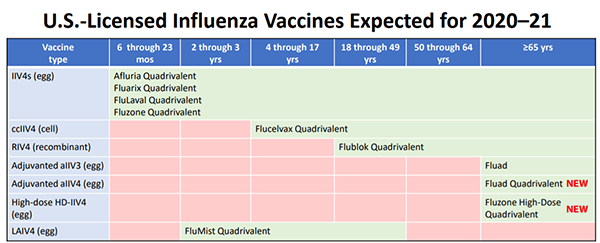
Please note:
Please encourage patients to complete vaccination in September or October, and continue to vaccinate as long as flu viruses are circulating, even in January or later.
Routine vaccination is an essential preventative care service that should not be delayed because of the COVID-19 pandemic. However, routine vaccination should be deferred for persons with suspected or confirmed COVID-19, regardless of symptoms, until criteria have been met for them to discontinue isolations. Postponing vaccination will avoid exposing healthcare personnel and other patients to the virus that causes COVID-19.
- No influenza vaccines are licensed for children under 6 months of age.
- For children 6 through 35 months of age, volume per dose is different than for older persons – refer to package insert for dose volumes.
- For many people, there is more than one appropriate vaccine.
- ACIP expresses no preference for any one influenza vaccine over another when more than one is appropriate.
- All are intramuscular except for LAIV4 (intranasal).
- LAIV4 should not be used in some groups, including pregnant women and certain other populations – refer to the ACIP statement from the CDC.
Please encourage patients to complete vaccination in September or October, and continue to vaccinate as long as flu viruses are circulating, even in January or later.
Routine vaccination is an essential preventative care service that should not be delayed because of the COVID-19 pandemic. However, routine vaccination should be deferred for persons with suspected or confirmed COVID-19, regardless of symptoms, until criteria have been met for them to discontinue isolations. Postponing vaccination will avoid exposing healthcare personnel and other patients to the virus that causes COVID-19.






© 2024 by Northwestern Medicine® and Northwestern Memorial HealthCare. Northwestern Medicine® is a trademark of Northwestern Memorial HealthCare.

|
Northwestern Memorial
312.926.2000 |
Central DuPage
630.933.1600 |
Lake Forest
847.234.5600 |
Delnor
630.208.3000 |
Kishwaukee
815.756.1521 |
Valley West
815.786.8484 |
Marianjoy
630.909.8000 |
|
©2024 by Northwestern Medicine® and Northwestern Memorial HealthCare. Northwestern Medicine® is a trademark of Northwestern Memorial HealthCare, used by Northwestern University.
|
|