NM Adopts New PYLARIFY PET Agent for More Accurate
Prostate Cancer Screenings
November 4, 2021 | 1 min. to read
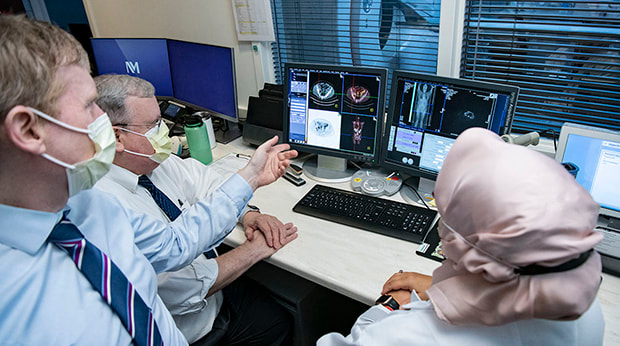
Ryan Avery, MD; Gary Dillehay, MD; and Hatice Savas, MD, review results of a prostate cancer test using the new PYLARIFY® radiopharmaceutical PET agent.
A new prostate cancer imaging agent is now being used at Northwestern Medicine to find prostate cancer in earlier stages, when it is more likely to have successful treatments.
This summer, Northwestern Memorial Hospital became the first hospital in Chicagoland to offer the positron emission tomography (PET) tests with the agent PYLARIFY®, also known as piflufolastat F 18. When this radioactive substance is injected, PYLARIFY targets the prostate-specific membrane antigen (PSMA), making this common sign of prostate cancer visible in molecular imaging.
The Food and Drug Administration (FDA) recently approved this PET agent after clinical trials. Edward Schaeffer, MD, PhD, chief urologist at NMH and chair of Department of Urology at Northwestern University Feinberg School of Medicine, is the primary investigator of an ongoing clinical trial using this agent at NM.
“Based on the cancer statistics, prostate cancer is the most common cancer diagnosed in the male population and the second leading cause of cancer-related death,” Dr. Schaeffer says. “This radiotracer lets us visualize suspected metastasis in lymph nodes, bone and soft tissue for initial staging for definitive treatment and also suspected recurrence when serum prostate-specific antigen (PSA) level is elevated.”
This summer, Northwestern Memorial Hospital became the first hospital in Chicagoland to offer the positron emission tomography (PET) tests with the agent PYLARIFY®, also known as piflufolastat F 18. When this radioactive substance is injected, PYLARIFY targets the prostate-specific membrane antigen (PSMA), making this common sign of prostate cancer visible in molecular imaging.
The Food and Drug Administration (FDA) recently approved this PET agent after clinical trials. Edward Schaeffer, MD, PhD, chief urologist at NMH and chair of Department of Urology at Northwestern University Feinberg School of Medicine, is the primary investigator of an ongoing clinical trial using this agent at NM.
“Based on the cancer statistics, prostate cancer is the most common cancer diagnosed in the male population and the second leading cause of cancer-related death,” Dr. Schaeffer says. “This radiotracer lets us visualize suspected metastasis in lymph nodes, bone and soft tissue for initial staging for definitive treatment and also suspected recurrence when serum prostate-specific antigen (PSA) level is elevated.”
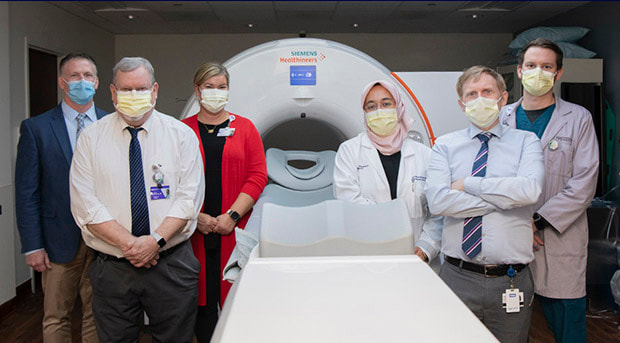
Tim Houston, PharmD; Gary Dillehay, MD; Lyndis Hay; Hatice Savas, MD; Ryan Avery, MD; and Logan Linscheid, CNMT, are part of the team that helped to implement the new PET agent.
Tim Houston, PharmD, director of Radiation Safety, Radiopharmacy and Medical Physics, says NM has plans to offer prostate cancer screenings using this new agent to all locations that have PET cameras systemwide.
NM scientists continue to research new ways to target and treat prostate cancer, including a clinical trial of another radiopharmaceutical, 177Lu-PSMA-617. This agent shows promise as a targeted treatment for patients with PSMA-positive metastatic castration-resistant prostate cancer.
“With the FDA approval of the diagnostic agent, we are excited about the opportunity to not just help in the diagnosis but also look forward to offering a targeted treatment for these patients,” Houston says.
NM scientists continue to research new ways to target and treat prostate cancer, including a clinical trial of another radiopharmaceutical, 177Lu-PSMA-617. This agent shows promise as a targeted treatment for patients with PSMA-positive metastatic castration-resistant prostate cancer.
“With the FDA approval of the diagnostic agent, we are excited about the opportunity to not just help in the diagnosis but also look forward to offering a targeted treatment for these patients,” Houston says.






© 2024 by Northwestern Medicine® and Northwestern Memorial HealthCare. Northwestern Medicine® is a trademark of Northwestern Memorial HealthCare.

|
Northwestern Memorial
312.926.2000 |
Central DuPage
630.933.1600 |
Lake Forest
847.234.5600 |
Delnor
630.208.3000 |
Kishwaukee
815.756.1521 |
Valley West
815.786.8484 |
Marianjoy
630.909.8000 |
|
©2024 by Northwestern Medicine® and Northwestern Memorial HealthCare. Northwestern Medicine® is a trademark of Northwestern Memorial HealthCare, used by Northwestern University.
|
|