Why You Do What You Do: Deeba Masood, MD
May 27, 2021 | 4 min. to read
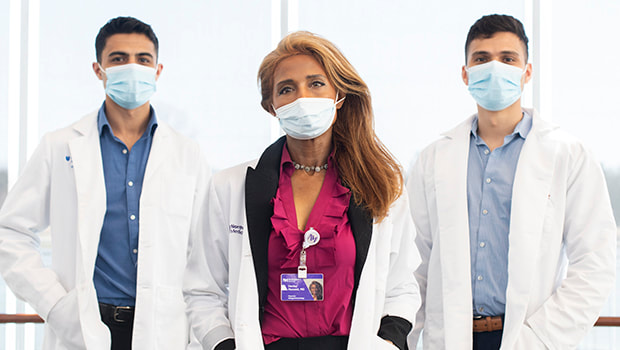
Deeba Masood, MD, is a board-certified allergist/immunologist at Lake Forest Hospital. She learned early in life the importance of education and civic duty, a journey she described recently in Sheridan Road magazine. Here, she shares how she has instilled those lessons into her practice.
Why did you choose to pursue a career in medicine?
I am passionate about science and love keeping up with the changing landscape of medicine. I also like being able to advocate for people. For me, advocacy is about stepping out of one’s comfort zone in defense of those who are subjected to an unjust cause. Physicians have the authority to make life-and-death decisions for their patients, and as such have a natural role as advocates.
I remember working in the ambulance bay during the early days of the pandemic, and there were so many COVID-19-positive patients we cared for who did not have the luxury to work from home. These patients were commonly dispositioned by underlying medical conditions. Now I can almost predict the outcome of a COVID-19 infection by glancing at the endomorphic habitus paired with the soft S4 whisper of a stiff ventricular wall.
As physicians, we are confronted at a personal level with complex psychological, financial and emotional factors that come into play during the course of treatment. I believe this degree of intimacy should propel us to stand up for patients.
I have tried to teach this to my children, Bijan and Arjan. To help them learn, we volunteered at a clinic for uninsured people on the South Side of Chicago throughout both of my sons’ high school careers. Now, they have both pursued paths in medicine and civic duty. Bijan is a student in Duke University’s dual MD/PhD program, where he volunteers by giving vaccines to older adults. Arjan is a medical student at Harvard, combining a dual degree in medicine and public policy where he volunteers by helping pregnant women who don’t have access to health care. As a Fulbright scholar, he went to Jamaica to help newborns with sickle cell have access to medical care.
I hope to have instilled a passion in my sons for making a difference in the lives of patients while being mindful of the social determinants of health care. This includes the impacts that language and literacy barriers, racism, discrimination and limited access to nutritious food can have on patients’ well-being and quality of life. Through these experiences, they have grown to be empathetic, compassionate, and to always be grateful and gracious for what they have.
Why did you choose allergy and immunology?
My first-hand experience led me to my specialty. I remember my childhood with asthma. Polyphonic wheeze was my lullaby — mixed with a cacophony of coughing and the feeling of concrete interlocking Lego bricks sitting on my chest.
Immunology is a fascinating field. Both allergy and immunology entities are based on inflammation, which can be extrapolated to other morbidities, such as stroke and heart disease. The dysfunctional interplay between the immune apparatus and lipids is what drives plaque inflammation through a complex cross-talk of inflammatory mediators, making this a very complex and fascinating field. One of the most interesting aspects of my practice has been the opportunity to utilize plasmapheresis to treat various autoimmune diseases.
I think it’s important to incorporate this integrative medical training into taking care of the patient as a whole. I always take time to address the anti-inflammatory factors of diet, exercise and mindfulness, and consider their impact on the patient’s quality of life.
What do you find most rewarding about your job?
Medicine gives me the adrenaline I seek in life. It challenges my curious mind and satisfies my innate desire to lend a helping hand. What a challenge and privilege it is to travel along its fractal patterns.
I also enjoy the diagnostic challenges we face. For example, I had an adolescent patient present with shortness of breath with exertion; she was labeled as having exercise-induced asthma. However, careful listening to her history prompted me to pursue cardiac etiology, where an EKG revealed prolonged QT interval, and resulted in an episode of torsades de pointes. After medical therapy failed, she received a pacemaker and was able to run a marathon the following year.
It’s really rewarding for me to receive letters of gratitude from my patients. One wrote, “Words are so inadequate when trying to express my most heartfelt gratitude for your kindness and compassion. You set such an outstanding example for your sons, who will be our next generation of physicians. I know you have instilled in them the importance of caring for those who are not fortunate enough to have access to good medical care, especially during this trying time of the pandemic we are all facing. They are so lucky to have you as a role model and a mother.” This is another reminder of why I do what I do.
What do you like to do outside of Northwestern Medicine?
I love to spend time on family hiking trips. In the summer of 2015, we reached the 20,000-foot summit to the roof of Africa, Kilimanjaro. I’ll never forget the stunning sunrise with crystal-clear cobalt blue skies. It was a surreal postcard of nature.
I also enjoy the practice of mindfulness, meditation, breath work for heart rate variability and writing poetry. It’s also important to me to practice an attitude of gratitude.
Why did you choose to pursue a career in medicine?
I am passionate about science and love keeping up with the changing landscape of medicine. I also like being able to advocate for people. For me, advocacy is about stepping out of one’s comfort zone in defense of those who are subjected to an unjust cause. Physicians have the authority to make life-and-death decisions for their patients, and as such have a natural role as advocates.
I remember working in the ambulance bay during the early days of the pandemic, and there were so many COVID-19-positive patients we cared for who did not have the luxury to work from home. These patients were commonly dispositioned by underlying medical conditions. Now I can almost predict the outcome of a COVID-19 infection by glancing at the endomorphic habitus paired with the soft S4 whisper of a stiff ventricular wall.
As physicians, we are confronted at a personal level with complex psychological, financial and emotional factors that come into play during the course of treatment. I believe this degree of intimacy should propel us to stand up for patients.
I have tried to teach this to my children, Bijan and Arjan. To help them learn, we volunteered at a clinic for uninsured people on the South Side of Chicago throughout both of my sons’ high school careers. Now, they have both pursued paths in medicine and civic duty. Bijan is a student in Duke University’s dual MD/PhD program, where he volunteers by giving vaccines to older adults. Arjan is a medical student at Harvard, combining a dual degree in medicine and public policy where he volunteers by helping pregnant women who don’t have access to health care. As a Fulbright scholar, he went to Jamaica to help newborns with sickle cell have access to medical care.
I hope to have instilled a passion in my sons for making a difference in the lives of patients while being mindful of the social determinants of health care. This includes the impacts that language and literacy barriers, racism, discrimination and limited access to nutritious food can have on patients’ well-being and quality of life. Through these experiences, they have grown to be empathetic, compassionate, and to always be grateful and gracious for what they have.
Why did you choose allergy and immunology?
My first-hand experience led me to my specialty. I remember my childhood with asthma. Polyphonic wheeze was my lullaby — mixed with a cacophony of coughing and the feeling of concrete interlocking Lego bricks sitting on my chest.
Immunology is a fascinating field. Both allergy and immunology entities are based on inflammation, which can be extrapolated to other morbidities, such as stroke and heart disease. The dysfunctional interplay between the immune apparatus and lipids is what drives plaque inflammation through a complex cross-talk of inflammatory mediators, making this a very complex and fascinating field. One of the most interesting aspects of my practice has been the opportunity to utilize plasmapheresis to treat various autoimmune diseases.
I think it’s important to incorporate this integrative medical training into taking care of the patient as a whole. I always take time to address the anti-inflammatory factors of diet, exercise and mindfulness, and consider their impact on the patient’s quality of life.
What do you find most rewarding about your job?
Medicine gives me the adrenaline I seek in life. It challenges my curious mind and satisfies my innate desire to lend a helping hand. What a challenge and privilege it is to travel along its fractal patterns.
I also enjoy the diagnostic challenges we face. For example, I had an adolescent patient present with shortness of breath with exertion; she was labeled as having exercise-induced asthma. However, careful listening to her history prompted me to pursue cardiac etiology, where an EKG revealed prolonged QT interval, and resulted in an episode of torsades de pointes. After medical therapy failed, she received a pacemaker and was able to run a marathon the following year.
It’s really rewarding for me to receive letters of gratitude from my patients. One wrote, “Words are so inadequate when trying to express my most heartfelt gratitude for your kindness and compassion. You set such an outstanding example for your sons, who will be our next generation of physicians. I know you have instilled in them the importance of caring for those who are not fortunate enough to have access to good medical care, especially during this trying time of the pandemic we are all facing. They are so lucky to have you as a role model and a mother.” This is another reminder of why I do what I do.
What do you like to do outside of Northwestern Medicine?
I love to spend time on family hiking trips. In the summer of 2015, we reached the 20,000-foot summit to the roof of Africa, Kilimanjaro. I’ll never forget the stunning sunrise with crystal-clear cobalt blue skies. It was a surreal postcard of nature.
I also enjoy the practice of mindfulness, meditation, breath work for heart rate variability and writing poetry. It’s also important to me to practice an attitude of gratitude.






© 2024 by Northwestern Medicine® and Northwestern Memorial HealthCare. Northwestern Medicine® is a trademark of Northwestern Memorial HealthCare.

|
Northwestern Memorial
312.926.2000 |
Central DuPage
630.933.1600 |
Lake Forest
847.234.5600 |
Delnor
630.208.3000 |
Kishwaukee
815.756.1521 |
Valley West
815.786.8484 |
Marianjoy
630.909.8000 |
|
©2024 by Northwestern Medicine® and Northwestern Memorial HealthCare. Northwestern Medicine® is a trademark of Northwestern Memorial HealthCare, used by Northwestern University.
|
|