Physician and Patient Findings Lead to FDA Label Change
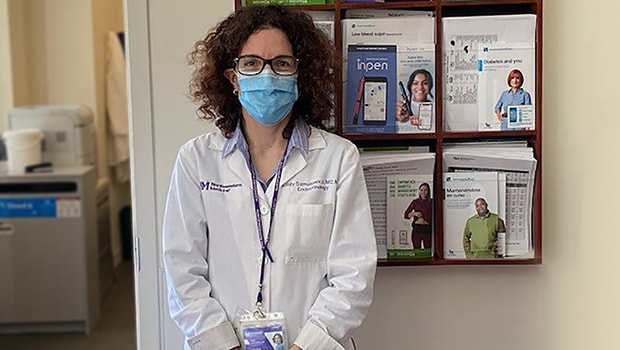
Emily Szmuilowicz, MD, and one of her patients with diabetes discover that a medication used to treat blood disorders caused the readings on the patient’s continuous glucose monitor to increase dramatically.
May XX, 2021 | 3 min. to read
At Northwestern Medicine Glenview Outpatient Center, Wendy Seibel, a 72-year-old patient with diabetes, had been seeing Northwestern Medical Group Endocrinologist Emily Szmuilowicz, MD, for years. During a routine appointment, Seibel informed Dr. Szmuilowicz that every time she took her hydroxyurea — a medication used to treat certain blood disorders — the readings on her continuous glucose monitor (CGM) would spike dramatically. The glucose readings would stay that way for about six hours and then would eventually come down. Though her CGM reading would be high, if she did a traditional finger stick glucose measurement, it was much lower. The results for the two methods were not consistent.
Seibel would try to switch up the times she took her medication to see if that made a difference, but the results continued to show that there was a spike in her glucose levels. She called Dexcom, the company that manufactures her CGM, to let them know what she was seeing, but hydroxyurea wasn’t on the list of medications that could potentially spike her glucose levels.
Since this had not been previously reported, Dr. Szmuilowicz decided to do some testing to confirm what her patient had observed. She asked Seibel to fast, then take her medication and compare the CGM reading to her finger stick glucose level every hour. Each time, even when she did not eat, the CGM showed a spike, but the finger stick did not. These results confirmed to Dr. Szmuilowicz that hydroxyurea was in fact likely interfering with the CGM readings.
“If my level was typically around 80, the CGM would show 180,” says Seibel.
Dr. Szmuilowicz discussed these findings with her colleague, NMG Endocrinologist Grazia Aleppo, MD. They reached out to the CGM manufacturer about what they found. The company performed their own testing and confirmed that hydroxyurea was interfering with Seibel’s glucose levels, which led to an official Food and Drug Administration (FDA) label change.
Seibel also wore two different glucose monitors simultaneously for two weeks, which showed divergent results and confirmed the interference. These findings were recently published in Diabetes Care.
“It makes me proud to see how a novel discovery and contribution has come out of our Glenview diabetes program, and that at the heart of the discovery was just listening to the patient,” says Dr. Szmuilowicz. “I think it says a lot about how we approach patient care.”
“The credit goes to Dr. Szmuilowicz,” says Seibel. “When I first called the company, they said it can’t be — even though I was convinced that it was happening. Dr. Szmuilowicz took the time to listen to me, was able to confirm my findings and worked hard to get this officially entered as medication that could affect blood glucose levels. She could have easily told me that it isn’t possible since it wasn’t on the original list. I’m relieved my findings were confirmed, so they can help others.”
“This really showcases the academic-community partnership that exists here,” says Micah Eimer, MD, an NMG cardiologist and medical director at Glenview Outpatient Center. “This also serves as a good reminder to always listen to the patient, no matter what the circumstances present. I’m incredibly proud that my colleague worked to make sure there was additional testing on this issue and saw it through until there was an FDA label change.”
Seibel mentioned that her daughter, who also has Type 1 diabetes, recently forwarded her an email she received from the company that produces her CGM, informing her that hydroxyurea is a medication that can spike glucose levels. She knew she received this warning because of her mom, who was determined to make a difference.
Seibel would try to switch up the times she took her medication to see if that made a difference, but the results continued to show that there was a spike in her glucose levels. She called Dexcom, the company that manufactures her CGM, to let them know what she was seeing, but hydroxyurea wasn’t on the list of medications that could potentially spike her glucose levels.
Since this had not been previously reported, Dr. Szmuilowicz decided to do some testing to confirm what her patient had observed. She asked Seibel to fast, then take her medication and compare the CGM reading to her finger stick glucose level every hour. Each time, even when she did not eat, the CGM showed a spike, but the finger stick did not. These results confirmed to Dr. Szmuilowicz that hydroxyurea was in fact likely interfering with the CGM readings.
“If my level was typically around 80, the CGM would show 180,” says Seibel.
Dr. Szmuilowicz discussed these findings with her colleague, NMG Endocrinologist Grazia Aleppo, MD. They reached out to the CGM manufacturer about what they found. The company performed their own testing and confirmed that hydroxyurea was interfering with Seibel’s glucose levels, which led to an official Food and Drug Administration (FDA) label change.
Seibel also wore two different glucose monitors simultaneously for two weeks, which showed divergent results and confirmed the interference. These findings were recently published in Diabetes Care.
“It makes me proud to see how a novel discovery and contribution has come out of our Glenview diabetes program, and that at the heart of the discovery was just listening to the patient,” says Dr. Szmuilowicz. “I think it says a lot about how we approach patient care.”
“The credit goes to Dr. Szmuilowicz,” says Seibel. “When I first called the company, they said it can’t be — even though I was convinced that it was happening. Dr. Szmuilowicz took the time to listen to me, was able to confirm my findings and worked hard to get this officially entered as medication that could affect blood glucose levels. She could have easily told me that it isn’t possible since it wasn’t on the original list. I’m relieved my findings were confirmed, so they can help others.”
“This really showcases the academic-community partnership that exists here,” says Micah Eimer, MD, an NMG cardiologist and medical director at Glenview Outpatient Center. “This also serves as a good reminder to always listen to the patient, no matter what the circumstances present. I’m incredibly proud that my colleague worked to make sure there was additional testing on this issue and saw it through until there was an FDA label change.”
Seibel mentioned that her daughter, who also has Type 1 diabetes, recently forwarded her an email she received from the company that produces her CGM, informing her that hydroxyurea is a medication that can spike glucose levels. She knew she received this warning because of her mom, who was determined to make a difference.






© 2024 by Northwestern Medicine® and Northwestern Memorial HealthCare. Northwestern Medicine® is a trademark of Northwestern Memorial HealthCare.

|
Northwestern Memorial
312.926.2000 |
Central DuPage
630.933.1600 |
Lake Forest
847.234.5600 |
Delnor
630.208.3000 |
Kishwaukee
815.756.1521 |
Valley West
815.786.8484 |
Marianjoy
630.909.8000 |
|
©2024 by Northwestern Medicine® and Northwestern Memorial HealthCare. Northwestern Medicine® is a trademark of Northwestern Memorial HealthCare, used by Northwestern University.
|
|