Lead Aprons To Be Discontinued for Patients
September 24, 2020 | 2 min. to read
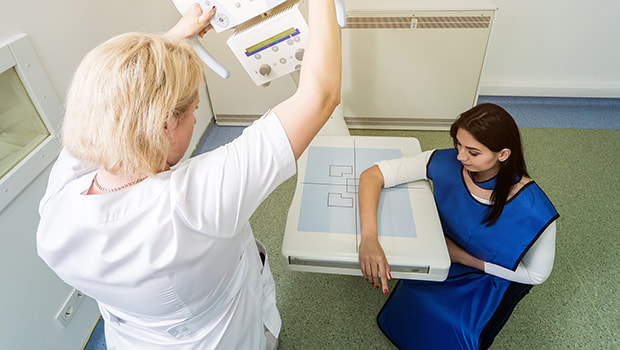
Northwestern Medicine is discontinuing the use of lead aprons during X-ray exams. The practice is now considered outdated by many organizations. including the Radiological Society of North America and the American College of Radiology. Studies show that not only do the aprons not provide the benefit once thought, they could actually have negative effects.
Radiation exposure used in modern diagnostic X-ray exams does not damage reproductive cells, scientists have concluded. Additionally, the lead shields may hide organs or body parts that physicians need to see, resulting in repeat X-ray exams.
Based on these studies and recommendations, NM hospitals will no longer use lead aprons in most cases. Exceptions could be made in situations where it provides a psychological benefit to the patient. Caregivers will provide information to patients about the decision if they have questions or concerns.
The change goes into effect October 5.
“The greatest part of this effort is we were able to advance care and best practices throughout the NM system in a united and collaborative way, with input and support from all our sites,” says Rajeev S. Polasani, MD, chair of Diagnostic Imaging at Central DuPage Hospital, who was instrumental in the initiative. Participants worked to achieve a consensus across NM sites and with partners at Ann & Robert H. Lurie Children’s Hospital of Chicago.
“The project was truly a team effort, with great contributions by many people throughout the system,” Dr. Polasani says. He extends special thanks to Nancy McDonald, director of radiation safety at NM, and Anzi Zhao, a diagnostic medical physicist at NM, for their outstanding work and leadership.
What you should know:
Radiation exposure used in modern diagnostic X-ray exams does not damage reproductive cells, scientists have concluded. Additionally, the lead shields may hide organs or body parts that physicians need to see, resulting in repeat X-ray exams.
Based on these studies and recommendations, NM hospitals will no longer use lead aprons in most cases. Exceptions could be made in situations where it provides a psychological benefit to the patient. Caregivers will provide information to patients about the decision if they have questions or concerns.
The change goes into effect October 5.
“The greatest part of this effort is we were able to advance care and best practices throughout the NM system in a united and collaborative way, with input and support from all our sites,” says Rajeev S. Polasani, MD, chair of Diagnostic Imaging at Central DuPage Hospital, who was instrumental in the initiative. Participants worked to achieve a consensus across NM sites and with partners at Ann & Robert H. Lurie Children’s Hospital of Chicago.
“The project was truly a team effort, with great contributions by many people throughout the system,” Dr. Polasani says. He extends special thanks to Nancy McDonald, director of radiation safety at NM, and Anzi Zhao, a diagnostic medical physicist at NM, for their outstanding work and leadership.
What you should know:
- In April 2019, the Food and Drug Administration recommended ending the use of patient shields to cover reproductive organs and unborn babies during diagnostic X-ray procedures.
- The American Association of Physicists in Medicine and other professional radiology societies recommend not using patient shields.
- Research conducted over more than 42 years has shown that radiation levels used in modern X-ray exams pose no risk to reproductive organs.
- NM X-ray, fluoroscopy and CT machines have sensors that automatically control how much radiation to use based on the part of the body being imaged. If a shield gets in the way of these sensors, the machine could deliver more radiation than necessary.
- Northwestern Medicine follows and trains all technologists in radiology standards of practice, such as the principles of ALARA (As Low As Reasonably Achievable), Image Gently and Image Wisely. These practices are used when performing all imaging tests that use radiation.






© 2024 by Northwestern Medicine® and Northwestern Memorial HealthCare. Northwestern Medicine® is a trademark of Northwestern Memorial HealthCare.

|
Northwestern Memorial
312.926.2000 |
Central DuPage
630.933.1600 |
Lake Forest
847.234.5600 |
Delnor
630.208.3000 |
Kishwaukee
815.756.1521 |
Valley West
815.786.8484 |
Marianjoy
630.909.8000 |
|
©2024 by Northwestern Medicine® and Northwestern Memorial HealthCare. Northwestern Medicine® is a trademark of Northwestern Memorial HealthCare, used by Northwestern University.
|
|