Shaiba Ansari-Ali, MD, Publishes Book About Her Stroke
May 27, 2021 | 4 min. to read
In 2016, Rheumatologist Shaiba Ansari-Ali, MD, survived a type of stroke that statistically has only a 0.00000004% chance of survival and recovery. Before the day that changed her life, Dr. Ansari-Ali was seeing about 75 patients a week, essentially a full-time patient load within a part-time schedule, and was actively involved in medical education. She was also a busy wife and mother, with two sons at home.
For years, Dr. Ansari-Ali had experienced increasingly intense migraines and persistent coughing from asthma. In the week leading up to her stroke, she felt deep neck and spine pain after an episode of severe coughing. Then one morning, she was finishing clinic notes at home when the room started to spin. She was having a stroke, and it was very serious.
Dr. Ansari-Ali had bilateral vertebral artery dissections and basilar artery stroke. Her constant coughing had ripped the lining from the two major blood vessels that go to the brain along the back of the neck. A clot formed and traveled up into the basilar artery — the major blood supply to the brain — leading to the presentation that made her neurologist suspect an internal capsule stroke. He first made sure she did not have a cerebral hemorrhage, and then ordered a dose of tissue plasminogen activator (tPA) to dissolve the clot.
After a few days, Dr. Ansari-Ali was discharged to Marianjoy Rehabilitation Hospital. There, due to a rare complication, she experienced hemorrhaging and coded twice. She was transferred to Central DuPage Hospital, where she underwent surgery for an infected groin hematoma, yet another setback. After a successful surgery, she was transferred back to Marianjoy, where her rehabilitation began again.
For three weeks, Dr. Ansari-Ali had days where she struggled both physically and emotionally, but her determination and progress led her home. There, she continued practicing what she learned in rehab and even created her own speech exercises. Incredibly, three months after her stroke, she returned to clinical practice, where she’s able to look back and appreciate the positive changes in her life.
Dr. Ansari-Ali first shared the story of her experience in the September 2018 issue of Medical Staff Minute. Now, with a few more years of recovery behind her, she’s written a book about it.
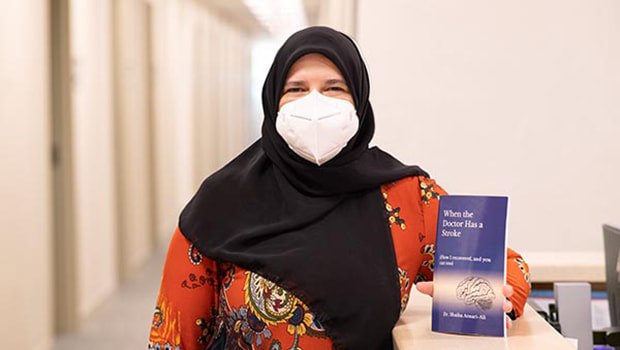
In her book, When the Doctor Has a Stroke (How I Recovered and You Can Too), Dr. Ansari-Ali shares her personal account and humorous insight as a physician who became a patient. She describes what she learned during a functional and meaningful recovery.
Dr. Ansari-Ali was recently interviewed about the book-writing process and what life is like for her today.
Tell us what perspective you may have gained by switching from the role of physician to patient — without having a choice — and how that has shaped your practice.
I take time to explain more to patients, and I always try to end the visit on a positive note. That’s something I kept with me from my time recovering at Marianjoy. The rehab team was very upbeat and encouraging, and I believe it helped my recovery. I want to be able to do the same for my patients. I want them to go home with a good feeling.
After your experience, writing and publishing a book is an incredible accomplishment. What inspired you to write the book, and what does it mean to you?
I felt like the universe came together and saved me, and I had to give something back. I knew I wanted to write a book, but I didn’t want it to be long and overly serious. My inspiration was actually TED Talks. So, I wrote one line a day for six months during the pandemic. The book itself is geared toward patients and caregivers, as well as medical trainees, because I want them to know how important it is to have this perspective.
What do you want other physicians to know when they read your story?
Enjoy what you do. I’m so thankful I can say that’s true for me. And everything happens for a reason, even if you may not like it. The number of patients I’m able to see in a day was cut in half. But the things that slowed me down because of the stroke actually made me a better physician. Now I’m able to spend more time with my patients, and that gives us both a new appreciation.
What advice would you share with someone who is recovering from stroke?
Again, everything happens for a reason. Be in the moment to heal, but look ahead to a year from now, two years from now, and things will be better. For me, it was a horrible dream in 2016, but since then it’s been improving. Take time to focus on healing and getting back to your life.
To “pay it forward,” I actually took copies of my book to Marianjoy for the patients and staff. They were instrumental in my healing, and I hope they find the book helpful.
For years, Dr. Ansari-Ali had experienced increasingly intense migraines and persistent coughing from asthma. In the week leading up to her stroke, she felt deep neck and spine pain after an episode of severe coughing. Then one morning, she was finishing clinic notes at home when the room started to spin. She was having a stroke, and it was very serious.
Dr. Ansari-Ali had bilateral vertebral artery dissections and basilar artery stroke. Her constant coughing had ripped the lining from the two major blood vessels that go to the brain along the back of the neck. A clot formed and traveled up into the basilar artery — the major blood supply to the brain — leading to the presentation that made her neurologist suspect an internal capsule stroke. He first made sure she did not have a cerebral hemorrhage, and then ordered a dose of tissue plasminogen activator (tPA) to dissolve the clot.
After a few days, Dr. Ansari-Ali was discharged to Marianjoy Rehabilitation Hospital. There, due to a rare complication, she experienced hemorrhaging and coded twice. She was transferred to Central DuPage Hospital, where she underwent surgery for an infected groin hematoma, yet another setback. After a successful surgery, she was transferred back to Marianjoy, where her rehabilitation began again.
For three weeks, Dr. Ansari-Ali had days where she struggled both physically and emotionally, but her determination and progress led her home. There, she continued practicing what she learned in rehab and even created her own speech exercises. Incredibly, three months after her stroke, she returned to clinical practice, where she’s able to look back and appreciate the positive changes in her life.
Dr. Ansari-Ali first shared the story of her experience in the September 2018 issue of Medical Staff Minute. Now, with a few more years of recovery behind her, she’s written a book about it.
In her book, When the Doctor Has a Stroke (How I Recovered and You Can Too), Dr. Ansari-Ali shares her personal account and humorous insight as a physician who became a patient. She describes what she learned during a functional and meaningful recovery.
Dr. Ansari-Ali was recently interviewed about the book-writing process and what life is like for her today.
Tell us what perspective you may have gained by switching from the role of physician to patient — without having a choice — and how that has shaped your practice.
I take time to explain more to patients, and I always try to end the visit on a positive note. That’s something I kept with me from my time recovering at Marianjoy. The rehab team was very upbeat and encouraging, and I believe it helped my recovery. I want to be able to do the same for my patients. I want them to go home with a good feeling.
After your experience, writing and publishing a book is an incredible accomplishment. What inspired you to write the book, and what does it mean to you?
I felt like the universe came together and saved me, and I had to give something back. I knew I wanted to write a book, but I didn’t want it to be long and overly serious. My inspiration was actually TED Talks. So, I wrote one line a day for six months during the pandemic. The book itself is geared toward patients and caregivers, as well as medical trainees, because I want them to know how important it is to have this perspective.
What do you want other physicians to know when they read your story?
Enjoy what you do. I’m so thankful I can say that’s true for me. And everything happens for a reason, even if you may not like it. The number of patients I’m able to see in a day was cut in half. But the things that slowed me down because of the stroke actually made me a better physician. Now I’m able to spend more time with my patients, and that gives us both a new appreciation.
What advice would you share with someone who is recovering from stroke?
Again, everything happens for a reason. Be in the moment to heal, but look ahead to a year from now, two years from now, and things will be better. For me, it was a horrible dream in 2016, but since then it’s been improving. Take time to focus on healing and getting back to your life.
To “pay it forward,” I actually took copies of my book to Marianjoy for the patients and staff. They were instrumental in my healing, and I hope they find the book helpful.






© 2024 by Northwestern Medicine® and Northwestern Memorial HealthCare. Northwestern Medicine® is a trademark of Northwestern Memorial HealthCare.

|
Northwestern Memorial
312.926.2000 |
Central DuPage
630.933.1600 |
Lake Forest
847.234.5600 |
Delnor
630.208.3000 |
Kishwaukee
815.756.1521 |
Valley West
815.786.8484 |
Marianjoy
630.909.8000 |
|
©2024 by Northwestern Medicine® and Northwestern Memorial HealthCare. Northwestern Medicine® is a trademark of Northwestern Memorial HealthCare, used by Northwestern University.
|
|