Team NM Volunteers Bring Food and Supplies to Bronzeville Residents
July 21, 2020 | 2 min. to read

COVID-19 has triggered a public health crisis with significant immediate and projected long-term impact on communities’ most vulnerable populations. From the start of the pandemic, Northwestern Medicine’s comprehensive response plan has included its community partners.
Using the system’s Community Health Needs Assessments, the Community Affairs team built a plan around the needs exacerbated by COVID-19. The factors impacting health that require immediate response include:
Using the system’s Community Health Needs Assessments, the Community Affairs team built a plan around the needs exacerbated by COVID-19. The factors impacting health that require immediate response include:
- Access to care
- Food insecurity
- Housing
- Mental and behavioral health, and health education
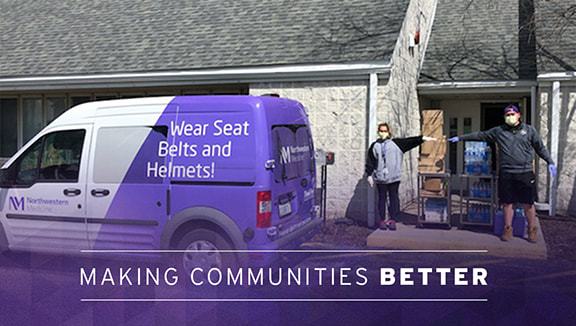
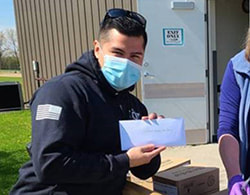
This first of a two-part series highlights a few of the efforts implemented by Northwestern Medicine to address access to care and food insecurity. Check back next week to learn about how NM is addressing housing, health education, and mental and behavioral health.
Access to care
NM has helped strengthen its Federally Qualified Health Centers partners with PPE and testing for the vulnerable. Nationwide shortages of PPE and supplies make it difficult for even large health systems to obtain enough supply; community-based healthcare organizations have found this particularly challenging. NM has provided emergency supplemental PPE to partners in healthcare and various health services agencies throughout Chicagoland to ensure they are able to deliver care in an environment that is safe for patients as well as care providers.
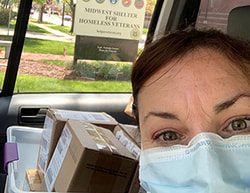
Pictured at right, an employee drops off personal care items and PPE at the Midwest Shelter for Homeless Veterans.
Access to care
NM has helped strengthen its Federally Qualified Health Centers partners with PPE and testing for the vulnerable. Nationwide shortages of PPE and supplies make it difficult for even large health systems to obtain enough supply; community-based healthcare organizations have found this particularly challenging. NM has provided emergency supplemental PPE to partners in healthcare and various health services agencies throughout Chicagoland to ensure they are able to deliver care in an environment that is safe for patients as well as care providers.
Pictured at right, an employee drops off personal care items and PPE at the Midwest Shelter for Homeless Veterans.
Food insecurity
Food security presented itself as an immediate need for the newly unemployed as well as children who suddenly could no longer receive consistent, healthy meals at school. Some of the 550 grocery store coupons donated by West Region employees as a part of the Season of Giving campaign went to support children in a local program that promotes school readiness for children ages birth to five from low-income families.
Members of the community who are homebound due to underlying health risks and who experience frequent food scarcity are also at particularly high risk for hunger during this time. In the Central Region, NM is deploying MedSpeed, its internal courier resource, and underwriting Lyft services to make deliveries from food pantries to clients’ homes.
NM has also donated PPE and PPE education, and emergency grants to food pantries that are connected to NM’s community partners.
Food security presented itself as an immediate need for the newly unemployed as well as children who suddenly could no longer receive consistent, healthy meals at school. Some of the 550 grocery store coupons donated by West Region employees as a part of the Season of Giving campaign went to support children in a local program that promotes school readiness for children ages birth to five from low-income families.
Members of the community who are homebound due to underlying health risks and who experience frequent food scarcity are also at particularly high risk for hunger during this time. In the Central Region, NM is deploying MedSpeed, its internal courier resource, and underwriting Lyft services to make deliveries from food pantries to clients’ homes.
NM has also donated PPE and PPE education, and emergency grants to food pantries that are connected to NM’s community partners.






© 2024 by Northwestern Medicine® and Northwestern Memorial HealthCare. Northwestern Medicine® is a trademark of Northwestern Memorial HealthCare.

|
Northwestern Memorial
312.926.2000 |
Central DuPage
630.933.1600 |
Lake Forest
847.234.5600 |
Delnor
630.208.3000 |
Kishwaukee
815.756.1521 |
Valley West
815.786.8484 |
Marianjoy
630.909.8000 |
|
©2024 by Northwestern Medicine® and Northwestern Memorial HealthCare. Northwestern Medicine® is a trademark of Northwestern Memorial HealthCare, used by Northwestern University.
|
|