Marianjoy CMO Turns to His Team for Help After a Stroke
October 21, 2021 | 3 min. to read
Mahesh V. Ramachandran, MD, a stroke rehabilitation specialist and chief medical officer at Marianjoy Rehabilitation Hospital, is dedicated to helping patients recover function and resume high-quality lives after stroke. On Memorial Day weekend, Dr. Ramachandran stumbled in his backyard; shortly after, he noticed sudden weakness in his left arm and leg — signs of stroke. As an expert in stroke who also has a family history of stroke, he knew to seek immediate medical attention.
An MRI showed he had an ischemic stroke in the left corona radiate, affecting sensation and motor function. While his cognition and speech were not affected, he experienced significant weakness of his arm and leg. After a brief stay at an acute care hospital, he was transferred to his own hospital, Marianjoy, for two weeks of inpatient therapy and subsequent outpatient care.
His care team — Sonia V. Sheth, MD, Nicholas Giovannetti, OT, Cora Mabulay, PT, and Jessica Raymond, MSN, RN — focused first on helping Dr. Ramachandran regain function for daily living. As he progressed in recovery, the focus shifted to strength and fine motor skills. He returned to full-time work in August, and continues to receive outpatient therapy. He has regained almost all former strength and coordination in his left leg, while his arm has about 80% of his former ability.
“I feel very proud of our team because how they cared for me, their compassion and effectiveness, is how they care for all our patients,” says Dr. Ramachandran. “I was not stressed because I knew I was in good hands and knew what the recovery pattern would be.”
His message for fellow physicians is two-fold: “First, if you have a patient who has experienced a stroke, Marianjoy treats more stroke patients through Medicare than any other hospital in Illinois and has deep expertise and the latest technologies,” he says. “The brain has a remarkable ability to reorganize and to connect new pathways. But beginning comprehensive rehabilitation earlier can lead to greater gains.”
The second part of Dr. Ramachandran’s message for physicians is the importance of self-care. “Eating right, daily exercise and rest are as essential to our well-being as they are to our patients’ well-being,” he says. He notes that, going forward, he expects to increase his focus on obtaining adequate rest.
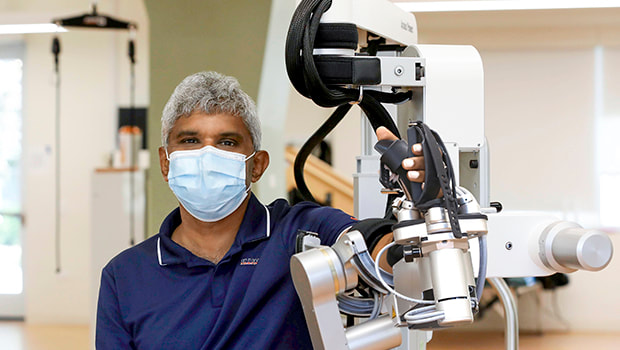
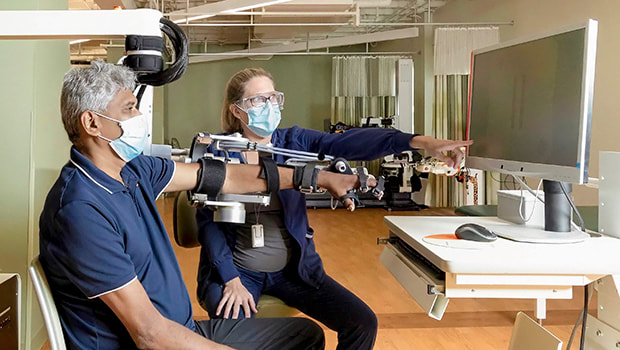
Dr. Ramachandran received care at the Tellabs Center for Neurorehabilitation and Neuroplasticity (TCNN) at Marianjoy, which incorporates advanced technology into the treatment of patients with stroke, brain injury, spinal cord injury and other neurological conditions. The individualized care plans may include the use of robotic aids, virtual reality and other devices to help patients rebuild damaged neural connections. For example, in his therapy, Dr. Ramachandran used both the Armeo®Power, a robotic exoskeleton for improving upper extremity strength and coordination, and the ZeroG® Gait and Balance System, a robotic body-weight support system used to improve walking.
The personal experience, he says, has deepened his understanding of his patients’ experience. “You can read about numbness and tingling that follow stroke, but the intensity of the sensations surprised me, and the fatigue during inpatient rehabilitation was worse,” he says. “I used to tell my patients to work hard and keep going, because of how important that is for recovery. The brain will improve on its own, just with time, but to get maximum return of function, it helps the more effort you put in. Now I will encourage my patients to push through but with plenty of rest breaks.”
An MRI showed he had an ischemic stroke in the left corona radiate, affecting sensation and motor function. While his cognition and speech were not affected, he experienced significant weakness of his arm and leg. After a brief stay at an acute care hospital, he was transferred to his own hospital, Marianjoy, for two weeks of inpatient therapy and subsequent outpatient care.
His care team — Sonia V. Sheth, MD, Nicholas Giovannetti, OT, Cora Mabulay, PT, and Jessica Raymond, MSN, RN — focused first on helping Dr. Ramachandran regain function for daily living. As he progressed in recovery, the focus shifted to strength and fine motor skills. He returned to full-time work in August, and continues to receive outpatient therapy. He has regained almost all former strength and coordination in his left leg, while his arm has about 80% of his former ability.
“I feel very proud of our team because how they cared for me, their compassion and effectiveness, is how they care for all our patients,” says Dr. Ramachandran. “I was not stressed because I knew I was in good hands and knew what the recovery pattern would be.”
His message for fellow physicians is two-fold: “First, if you have a patient who has experienced a stroke, Marianjoy treats more stroke patients through Medicare than any other hospital in Illinois and has deep expertise and the latest technologies,” he says. “The brain has a remarkable ability to reorganize and to connect new pathways. But beginning comprehensive rehabilitation earlier can lead to greater gains.”
The second part of Dr. Ramachandran’s message for physicians is the importance of self-care. “Eating right, daily exercise and rest are as essential to our well-being as they are to our patients’ well-being,” he says. He notes that, going forward, he expects to increase his focus on obtaining adequate rest.
Dr. Ramachandran received care at the Tellabs Center for Neurorehabilitation and Neuroplasticity (TCNN) at Marianjoy, which incorporates advanced technology into the treatment of patients with stroke, brain injury, spinal cord injury and other neurological conditions. The individualized care plans may include the use of robotic aids, virtual reality and other devices to help patients rebuild damaged neural connections. For example, in his therapy, Dr. Ramachandran used both the Armeo®Power, a robotic exoskeleton for improving upper extremity strength and coordination, and the ZeroG® Gait and Balance System, a robotic body-weight support system used to improve walking.
The personal experience, he says, has deepened his understanding of his patients’ experience. “You can read about numbness and tingling that follow stroke, but the intensity of the sensations surprised me, and the fatigue during inpatient rehabilitation was worse,” he says. “I used to tell my patients to work hard and keep going, because of how important that is for recovery. The brain will improve on its own, just with time, but to get maximum return of function, it helps the more effort you put in. Now I will encourage my patients to push through but with plenty of rest breaks.”






© 2024 by Northwestern Medicine® and Northwestern Memorial HealthCare. Northwestern Medicine® is a trademark of Northwestern Memorial HealthCare.

|
Northwestern Memorial
312.926.2000 |
Central DuPage
630.933.1600 |
Lake Forest
847.234.5600 |
Delnor
630.208.3000 |
Kishwaukee
815.756.1521 |
Valley West
815.786.8484 |
Marianjoy
630.909.8000 |
|
©2024 by Northwestern Medicine® and Northwestern Memorial HealthCare. Northwestern Medicine® is a trademark of Northwestern Memorial HealthCare, used by Northwestern University.
|
|