Lung Transplant Program on Track to Double in Volume
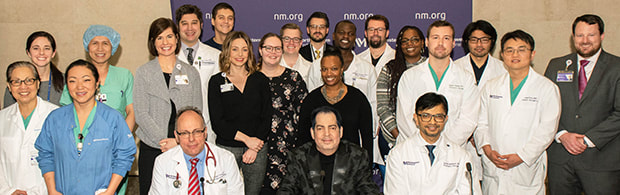
Members of the Northwestern Medicine Lung Transplant Team pose with Tommy Lipnick, a Chicago-born music producer, who in late 2019 became the 100th patient to receive a lung transplant at NM.
May 27, 2021 | 5 min. to read
A few months into the pandemic, the Northwestern Medicine Lung Transplant Program performed a first-in-the-world double-lung transplant on a patient whose own lungs had been destroyed by COVID-19. A year later, the program is an international center for post-COVID-19 double-lung transplants, even as the number of lung transplants the program performs for other reasons continues to grow.
A large and expert team enables those feats. Every lung transplant requires not only numerous specialist physicians and nurses, but also a wide array of other experts, including organ procurement specialists, social workers, physical and respiratory therapists, pharmacists, dieticians, patient and financial liaisons, transplant coordinators and others.
“All the team members are very devoted and hard-working, and there is no obstacle that will stop them from helping our patients,” says Pulmonologist Rade Tomic, MD, medical director of the Lung Transplant Program. “I am honored to work with them.”
Since that first double-lung transplant for a COVID-19 patient in June 2020, the Lung Transplant team has performed a total of 19 such procedures as of mid-May — thought to be the most of any program in the world. Adding in lung transplants from other causes, NM is on track to exceed 60 lung transplants in fiscal year 2021, a number that is a program high and about double the previously anticipated volume.
A large and expert team enables those feats. Every lung transplant requires not only numerous specialist physicians and nurses, but also a wide array of other experts, including organ procurement specialists, social workers, physical and respiratory therapists, pharmacists, dieticians, patient and financial liaisons, transplant coordinators and others.
“All the team members are very devoted and hard-working, and there is no obstacle that will stop them from helping our patients,” says Pulmonologist Rade Tomic, MD, medical director of the Lung Transplant Program. “I am honored to work with them.”
Since that first double-lung transplant for a COVID-19 patient in June 2020, the Lung Transplant team has performed a total of 19 such procedures as of mid-May — thought to be the most of any program in the world. Adding in lung transplants from other causes, NM is on track to exceed 60 lung transplants in fiscal year 2021, a number that is a program high and about double the previously anticipated volume.
To understand the magnitude of the team’s effort, it helps to know:
Accelerating growth
The NM Lung Transplant Program dates to 2013 when Thoracic Surgeon Ankit Bharat, MD, was recruited to serve as its surgical director. Dr. Bharat and his team performed the program’s first lung transplant in 2014. In late 2018, Dr. Tomic joined as medical director.
By that time, the NM program volume had grown to 25 procedures a year. Few lung transplant programs exceed 75 procedures a year. An annual volume of 50 is considered the threshold for being a large-volume program.
When the COVID-19 pandemic began, the NM program had just completed its 100th lung transplant since 2014 and was projecting 27 procedures for FY20, a modest but steady growth. Instead, in FY20, the team completed 44 transplants — a 63% growth year-over-year. If NM exceeds 60 lung transplants in FY21 as expected, the program will have doubled its lung transplant volume over the past two years and entered the large-volume category.
- How rapidly the NM Lung Transplant Program has grown
- How extensive the support and care is for lung transplant patients, especially when the cause is damage from COVID-19
Accelerating growth
The NM Lung Transplant Program dates to 2013 when Thoracic Surgeon Ankit Bharat, MD, was recruited to serve as its surgical director. Dr. Bharat and his team performed the program’s first lung transplant in 2014. In late 2018, Dr. Tomic joined as medical director.
By that time, the NM program volume had grown to 25 procedures a year. Few lung transplant programs exceed 75 procedures a year. An annual volume of 50 is considered the threshold for being a large-volume program.
When the COVID-19 pandemic began, the NM program had just completed its 100th lung transplant since 2014 and was projecting 27 procedures for FY20, a modest but steady growth. Instead, in FY20, the team completed 44 transplants — a 63% growth year-over-year. If NM exceeds 60 lung transplants in FY21 as expected, the program will have doubled its lung transplant volume over the past two years and entered the large-volume category.
|
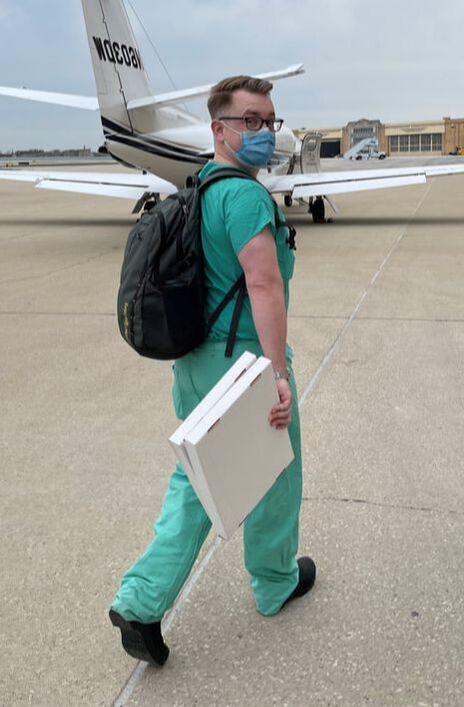
"When the pandemic hit, our response — unlike much of the lung transplant community — was not to ramp down,” recalls Jeff Lysne, MS, the Lung Transplant Program’s lead organ procurement specialist (pictured on a procurement).
“Dr. Bharat thought we could safely transplant throughout the pandemic, and the need was dire," Lysne says. "Even before the first COVID-19 patient, we were the busiest we had ever been, and it only got busier.” For Lysne, one of the satisfying successes of the past year was a transplant for a non-COVID-19 patient, who had waited a long time for a compatible donor. During the pandemic, a match came up, and the Lung Transplant Program, having continued full operations, was able to help her. “I visited her a month later, and she looked like a totally different person; she’s able to breathe again,” Lysne says. |
A more urgent time frame
As a leader and innovator in the response to COVID-19, the NM Lung Transplant Program has received more than 190 referrals for post-COVID-19 patients. Many may not be appropriate candidates, but with patients often already on advanced life support, evaluations and every subsequent step must occur quickly.
That dynamic is vastly different from lung transplants due to long-term, progressive disease, the pre-pandemic norm, says Mike Bielaczyc, LCSW, CCTSW, Lung Transplant social worker. “Traditionally, patients are assessed medically and psychosocially in a series of appointments over months,” Bielaczyc explains. “They are accustomed to being on multiple medications with frequent appointments, and before a transplant, they have time to educate themselves and to put in place a support system, insurance and financial plan.”
He continues, “With COVID-19, we have to do these evaluations very quickly, by phone and video, when the patients might be too sick to be involved and their families do not have all that experience being caregivers. With much, much less preparation, a COVID-19 patient will wake up with new lungs, and find themselves on intense medication, living here for the next year of recovery.”
As a leader and innovator in the response to COVID-19, the NM Lung Transplant Program has received more than 190 referrals for post-COVID-19 patients. Many may not be appropriate candidates, but with patients often already on advanced life support, evaluations and every subsequent step must occur quickly.
That dynamic is vastly different from lung transplants due to long-term, progressive disease, the pre-pandemic norm, says Mike Bielaczyc, LCSW, CCTSW, Lung Transplant social worker. “Traditionally, patients are assessed medically and psychosocially in a series of appointments over months,” Bielaczyc explains. “They are accustomed to being on multiple medications with frequent appointments, and before a transplant, they have time to educate themselves and to put in place a support system, insurance and financial plan.”
He continues, “With COVID-19, we have to do these evaluations very quickly, by phone and video, when the patients might be too sick to be involved and their families do not have all that experience being caregivers. With much, much less preparation, a COVID-19 patient will wake up with new lungs, and find themselves on intense medication, living here for the next year of recovery.”
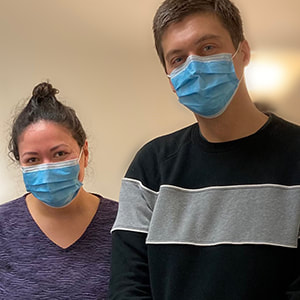
For the program’s social workers — Bielaczyc and Grecia Herrera, LCSW (pictured together) — these changes often mean increasing the already extensive support they provide. For example, for a postpartum COVID-19 patient from Ohio for whom English is a second language, Herrera arranged housing for her family, schooling for her children, home health care and natal care. “It was a heavy lift but very rewarding,” she says.
Currently, in addition to its physicians, the Lung Transplant Program has a dedicated team of 12 people — up from eight in 2017 — who provide administrative and allied health services, and there are plans in place to add three more positions. The broader team includes advanced practice providers (APPs) and nurses from the Advanced Lung Disease inpatient team and Thoracic Surgery, as well physical and respiratory therapists. In addition, collaborating teams in departments such as Dental, Dermatology, Diagnostic Imaging and Infectious Disease are critical to completing the full health exams required to assess potential transplant patients. Nurses and care teams from Surgical Services and the ICU round out the comprehensive, multidisciplinary effort required.
All of these team members have stepped up to meet the accelerated turnaround and increased demand, says Jennifer Wright, APRN, CNP, Lung Transplant APP. “It takes so many people to make these transplants happen,” Wright says. “And COVID-19 has applied a lot more pressure to everyone. But the reward is you’re fighting the battle, together, with your patients and their families.”
Currently, in addition to its physicians, the Lung Transplant Program has a dedicated team of 12 people — up from eight in 2017 — who provide administrative and allied health services, and there are plans in place to add three more positions. The broader team includes advanced practice providers (APPs) and nurses from the Advanced Lung Disease inpatient team and Thoracic Surgery, as well physical and respiratory therapists. In addition, collaborating teams in departments such as Dental, Dermatology, Diagnostic Imaging and Infectious Disease are critical to completing the full health exams required to assess potential transplant patients. Nurses and care teams from Surgical Services and the ICU round out the comprehensive, multidisciplinary effort required.
All of these team members have stepped up to meet the accelerated turnaround and increased demand, says Jennifer Wright, APRN, CNP, Lung Transplant APP. “It takes so many people to make these transplants happen,” Wright says. “And COVID-19 has applied a lot more pressure to everyone. But the reward is you’re fighting the battle, together, with your patients and their families.”
- Read Mayra’s Story: Breathing New Life Into the Battle, the story of the first double-lung transplant for a COVID-19 patient.
- Watch an 18-second video showing the damage COVID-19 can wreak on lungs.






© 2024 by Northwestern Medicine® and Northwestern Memorial HealthCare. Northwestern Medicine® is a trademark of Northwestern Memorial HealthCare.

|
Northwestern Memorial
312.926.2000 |
Central DuPage
630.933.1600 |
Lake Forest
847.234.5600 |
Delnor
630.208.3000 |
Kishwaukee
815.756.1521 |
Valley West
815.786.8484 |
Marianjoy
630.909.8000 |
|
©2024 by Northwestern Medicine® and Northwestern Memorial HealthCare. Northwestern Medicine® is a trademark of Northwestern Memorial HealthCare, used by Northwestern University.
|
|