Interventional Pulmonary Achieves New Standard for COVID-19 Patients
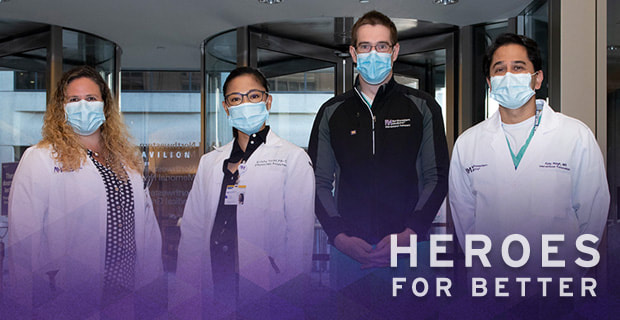
With Northwestern Memorial Hospital receiving some of Chicago’s most critically ill COVID-19 cases, the hospital’s four-person Interventional Pulmonary team — Christine Argento, MD, Kristy Todd, MD, Sean Smith, MD, and Ajay Wagh, MD — has been integral to patient care on the front lines of the pandemic. Prolonged ventilation support is often required for COVID-19 ICU patients, and as a result, tracheostomy is an essential procedure that the team has been called on repeatedly to perform.
Prior to the COVID-19 pandemic, the Interventional Pulmonary team typically performed about two or three tracheostomies a month. From late March, when critically ill patients began being admitted to NMH, and on into June, that number rose to about 12 a month. Knowing the demand for tracheostomies would increase dramatically, and also knowing the aerosol-generating procedure would increase the risk of staff exposure, the team acted quickly to redesign their tracheostomy protocol to help enhance both patient and staff safety.
“Tracheostomy is a high-risk procedure because the team is accessing the airway,” says Dr. Argento. “The team determined a safe and consistent way to perform the procedure on patients with COVID-19, and because of this, we have been able to keep the ICU teams safe with every procedure.”
Early in the pandemic, the team created a process that would reduce the number of people needed for the procedure and make the process more seamless, so it could be replicated consistently. A typical tracheostomy involves a nurse, at least two interventional pulmonologists and a respiratory therapist, Dr. Argento says. With their new process, the team was able to reduce that number to three people: two interventional pulmonologists, and either an anesthesiologist or a certified registered nurse anesthetist (CRNA).
“A tracheostomy requires the patient to be completely sedated,” says Dr. Argento. “Since many COVID ICU patients are given high doses of paralytics during the course of treatment, an anesthesiologist or CRNA has more in their playbook to help sedate patients.”
In addition to reducing the number of staff need to perform a tracheostomy, the Interventional Pulmonary team also modified the procedure so certain aspects of the tracheostomy are performed apneic by temporarily suspending patient breathing to reduce aerosol generation during key moments. Combined, the changes have shortened procedure time, increased patient safety and reduced staff exposure.
“Our Interventional Pulmonary team has been extraordinary during the COVID pandemic, performing more than 30 tracheostomies for our COVID ICU patients,” says NMH Patient Care Manager Leah Prendergarst in her Heroes For Better submission. “This is a high-risk procedure because the team is accessing the airway to place the trach. The team immediately recognized the need to determine a safe and consistent way to perform COVID tracheostomies, and because of this, they have kept our ICU teams safe with every procedure! Thank you to the Interventional Pulmonary team from the entire ICU staff!”
“It’s all about teamwork,” Dr. Argento says. “We met with colleagues from Nursing and Respiratory Therapy to discuss the procedure and to ensure we were keeping them in mind as we created the new protocol. Our goal was to ensure patient and provider safety, and to create a procedure that each member of the team could perform seamlessly and consistently every time.”
The new tracheostomy protocol has been so successful that the Interventional Pulmonary team has shared it with more than a dozen colleagues, and the procedure is now in use at hospitals across the country.
Prior to the COVID-19 pandemic, the Interventional Pulmonary team typically performed about two or three tracheostomies a month. From late March, when critically ill patients began being admitted to NMH, and on into June, that number rose to about 12 a month. Knowing the demand for tracheostomies would increase dramatically, and also knowing the aerosol-generating procedure would increase the risk of staff exposure, the team acted quickly to redesign their tracheostomy protocol to help enhance both patient and staff safety.
“Tracheostomy is a high-risk procedure because the team is accessing the airway,” says Dr. Argento. “The team determined a safe and consistent way to perform the procedure on patients with COVID-19, and because of this, we have been able to keep the ICU teams safe with every procedure.”
Early in the pandemic, the team created a process that would reduce the number of people needed for the procedure and make the process more seamless, so it could be replicated consistently. A typical tracheostomy involves a nurse, at least two interventional pulmonologists and a respiratory therapist, Dr. Argento says. With their new process, the team was able to reduce that number to three people: two interventional pulmonologists, and either an anesthesiologist or a certified registered nurse anesthetist (CRNA).
“A tracheostomy requires the patient to be completely sedated,” says Dr. Argento. “Since many COVID ICU patients are given high doses of paralytics during the course of treatment, an anesthesiologist or CRNA has more in their playbook to help sedate patients.”
In addition to reducing the number of staff need to perform a tracheostomy, the Interventional Pulmonary team also modified the procedure so certain aspects of the tracheostomy are performed apneic by temporarily suspending patient breathing to reduce aerosol generation during key moments. Combined, the changes have shortened procedure time, increased patient safety and reduced staff exposure.
“Our Interventional Pulmonary team has been extraordinary during the COVID pandemic, performing more than 30 tracheostomies for our COVID ICU patients,” says NMH Patient Care Manager Leah Prendergarst in her Heroes For Better submission. “This is a high-risk procedure because the team is accessing the airway to place the trach. The team immediately recognized the need to determine a safe and consistent way to perform COVID tracheostomies, and because of this, they have kept our ICU teams safe with every procedure! Thank you to the Interventional Pulmonary team from the entire ICU staff!”
“It’s all about teamwork,” Dr. Argento says. “We met with colleagues from Nursing and Respiratory Therapy to discuss the procedure and to ensure we were keeping them in mind as we created the new protocol. Our goal was to ensure patient and provider safety, and to create a procedure that each member of the team could perform seamlessly and consistently every time.”
The new tracheostomy protocol has been so successful that the Interventional Pulmonary team has shared it with more than a dozen colleagues, and the procedure is now in use at hospitals across the country.






© 2024 by Northwestern Medicine® and Northwestern Memorial HealthCare. Northwestern Medicine® is a trademark of Northwestern Memorial HealthCare.

|
Northwestern Memorial
312.926.2000 |
Central DuPage
630.933.1600 |
Lake Forest
847.234.5600 |
Delnor
630.208.3000 |
Kishwaukee
815.756.1521 |
Valley West
815.786.8484 |
Marianjoy
630.909.8000 |
|
©2024 by Northwestern Medicine® and Northwestern Memorial HealthCare. Northwestern Medicine® is a trademark of Northwestern Memorial HealthCare, used by Northwestern University.
|
|