Heroes for Better: The Rehabilitative Services Team at Lake Forest Hospital
May 13, 2020 | 3 min. to read
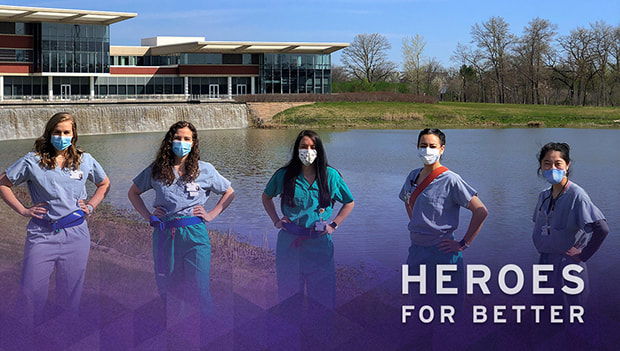
Although the entire Rehabilitative Services team at Lake Forest Hospital was already tight-knit, the connection among team members has been magnified during the pandemic.
“This team creatively helps patients regain independence, maintain or improve function, and facilitate a safe discharge daily,” says Corey Manny, DPT, manager of Rehabilitative Services at Lake Forest Hospital.
These unprecedented times call for unusual measures. “There has been an increase of innovation during this time of difficulty,” says Donna Wagner, operations coordinator of Rehabilitative Services. “It’s evident through the team and hospital commitment to the Patients First mission.”
While some think of rehabilitation as something that happens after an illness or injury, the team has been providing key support for patients who are hospitalized for COVID-19 and for the staff caring for them.
Rehabilitation and proning
For example, Katie Brito, DPT, a physical therapist at LFH, works extensively with ICU physicians and Nursing staff to assist with appropriate positioning to minimize pressure injuries. She wants to make sure staff feels confident providing care to patients on ventilators who are in the prone position (flat on the chest). “We want to work as a team and make sure we’re not exerting our bodies or hurting ourselves, while optimizing the patient’s position for comfort,” says Brito.
Because not every patient presents the same, Brito has compiled resources for staff to understand the latest research findings based on her research. “We walk into the room more confident and have a better mindset when we are better prepared,” explains Brito. “The primary thing is keeping them safe.”
Also leading this approach are Rachel Bradley, DPT, Mary Cecilia Daly and Brittany Branstetter. Brito credits the team’s proactive approach and the support of Randy P. Orr, MD, Pulmonology and Critical Care Medicine specialist, for making this possible. “This partnership and the fostering of what we have created here could not have been done without Dr. Orr recognizing our skilled input and continuing to listen.”
Rehabilitation and communication
Another example is Marilyn Garces, a speech language pathologist, for whom Patients First has been a key guiding principle. And with the help of Mary Ann Blendonohy, the two have managed to provide seamless care during this time.
Garces, who was hospitalized last year, knows how lonely and scared patients can feel. Those feelings are now compounded by the fact that patients are unable to have visitors. To help patients cope, Garces created communication boards that patients with a ventilator or tracheostomy can use to communicate their needs.
After patients are extubated, an evaluation is required, often before patients are able to eat or drink. Garces immediately worked on addressing this issue. “I worked primarily with Dr. Orr to allow protocol to ensure patients with mild symptoms were seen within 24 hours,” says Garces. “This ensures patients are able to safely consume an appropriate diet as soon as possible.”
Additionally, Garces has created an evidence-based screening tool and a decision tree to assist Nursing staff in determining when to order speech services.
Garces has made it a priority to take the extra time to truly connect with patients during their therapy. “Particularly during COVID, I’ve been thinking a lot about the value of presence and how to humanize the experience of illness. I try to sit down when I’m in a room, take time to hear about patients’ lives beyond COVID and make a personal connection."
Team approach
Everyone agrees the successful COVID-19 response has taken a team effort, both within LFH and across Northwestern Medicine. In fact, the Rehabilitation Services team had an assist from rehabilitation colleagues at Northwestern Memorial Hospital, who helped prepare them to meet the unique needs of patients with COVID-19.
Additionally, the team has implemented daily huddles with all people involved in rehabilitative care to communicate efficiently and ensure continuity.
“It’s been a feeling of utter amazement of how our community and colleagues have joined together during a time of global distress,” says Manny. “No matter how this pandemic affects our team, everyone supports each other. With tremendous social and economic change to our daily lives, there’s still the same great dedication to our patients.”
Heroes for Better is a campaign to honor our workforce during the COVID-19 pandemic. We are seeking stories, photos or art that show teamwork, impactful interactions and inspiring moments. Some of your stories may be shared on NM Interactive, nm.org and/or NM social media channels. Submit your story by emailing [email protected].
“This team creatively helps patients regain independence, maintain or improve function, and facilitate a safe discharge daily,” says Corey Manny, DPT, manager of Rehabilitative Services at Lake Forest Hospital.
These unprecedented times call for unusual measures. “There has been an increase of innovation during this time of difficulty,” says Donna Wagner, operations coordinator of Rehabilitative Services. “It’s evident through the team and hospital commitment to the Patients First mission.”
While some think of rehabilitation as something that happens after an illness or injury, the team has been providing key support for patients who are hospitalized for COVID-19 and for the staff caring for them.
Rehabilitation and proning
For example, Katie Brito, DPT, a physical therapist at LFH, works extensively with ICU physicians and Nursing staff to assist with appropriate positioning to minimize pressure injuries. She wants to make sure staff feels confident providing care to patients on ventilators who are in the prone position (flat on the chest). “We want to work as a team and make sure we’re not exerting our bodies or hurting ourselves, while optimizing the patient’s position for comfort,” says Brito.
Because not every patient presents the same, Brito has compiled resources for staff to understand the latest research findings based on her research. “We walk into the room more confident and have a better mindset when we are better prepared,” explains Brito. “The primary thing is keeping them safe.”
Also leading this approach are Rachel Bradley, DPT, Mary Cecilia Daly and Brittany Branstetter. Brito credits the team’s proactive approach and the support of Randy P. Orr, MD, Pulmonology and Critical Care Medicine specialist, for making this possible. “This partnership and the fostering of what we have created here could not have been done without Dr. Orr recognizing our skilled input and continuing to listen.”
Rehabilitation and communication
Another example is Marilyn Garces, a speech language pathologist, for whom Patients First has been a key guiding principle. And with the help of Mary Ann Blendonohy, the two have managed to provide seamless care during this time.
Garces, who was hospitalized last year, knows how lonely and scared patients can feel. Those feelings are now compounded by the fact that patients are unable to have visitors. To help patients cope, Garces created communication boards that patients with a ventilator or tracheostomy can use to communicate their needs.
After patients are extubated, an evaluation is required, often before patients are able to eat or drink. Garces immediately worked on addressing this issue. “I worked primarily with Dr. Orr to allow protocol to ensure patients with mild symptoms were seen within 24 hours,” says Garces. “This ensures patients are able to safely consume an appropriate diet as soon as possible.”
Additionally, Garces has created an evidence-based screening tool and a decision tree to assist Nursing staff in determining when to order speech services.
Garces has made it a priority to take the extra time to truly connect with patients during their therapy. “Particularly during COVID, I’ve been thinking a lot about the value of presence and how to humanize the experience of illness. I try to sit down when I’m in a room, take time to hear about patients’ lives beyond COVID and make a personal connection."
Team approach
Everyone agrees the successful COVID-19 response has taken a team effort, both within LFH and across Northwestern Medicine. In fact, the Rehabilitation Services team had an assist from rehabilitation colleagues at Northwestern Memorial Hospital, who helped prepare them to meet the unique needs of patients with COVID-19.
Additionally, the team has implemented daily huddles with all people involved in rehabilitative care to communicate efficiently and ensure continuity.
“It’s been a feeling of utter amazement of how our community and colleagues have joined together during a time of global distress,” says Manny. “No matter how this pandemic affects our team, everyone supports each other. With tremendous social and economic change to our daily lives, there’s still the same great dedication to our patients.”
Heroes for Better is a campaign to honor our workforce during the COVID-19 pandemic. We are seeking stories, photos or art that show teamwork, impactful interactions and inspiring moments. Some of your stories may be shared on NM Interactive, nm.org and/or NM social media channels. Submit your story by emailing [email protected].






© 2024 by Northwestern Medicine® and Northwestern Memorial HealthCare. Northwestern Medicine® is a trademark of Northwestern Memorial HealthCare.

|
Northwestern Memorial
312.926.2000 |
Central DuPage
630.933.1600 |
Lake Forest
847.234.5600 |
Delnor
630.208.3000 |
Kishwaukee
815.756.1521 |
Valley West
815.786.8484 |
Marianjoy
630.909.8000 |
|
©2024 by Northwestern Medicine® and Northwestern Memorial HealthCare. Northwestern Medicine® is a trademark of Northwestern Memorial HealthCare, used by Northwestern University.
|
|